Emerging Markets Rally, Despite Eurozone Debt Crisis

It looks like emerging market investors took my last post (“Investors” Shouldn’t Worry about the Euro) to heart, since emerging markets (EM) have continued to rally in spite of the Euro’s woes. To be sure, EM stocks, bonds, and currencies all dipped slightly in May when the crisis reached fever pitch, but they have since recovered their losses and are once again en route to record highs.
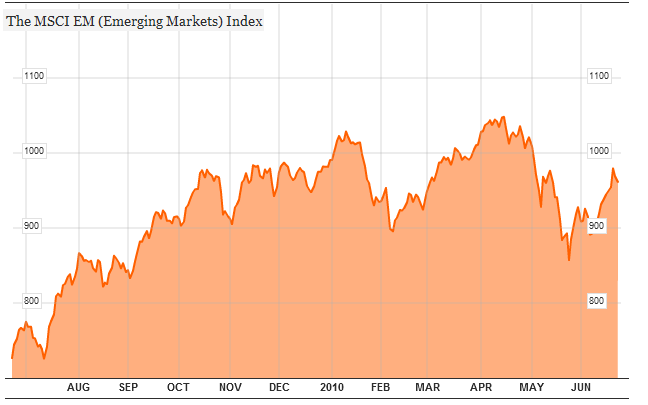
MSCI Stock Index 2010

That’s not to say that that surge in risk-aversion wasn’t justified. In fact, investors are continuing to punish the Eurozone as well as a handful of other risky areas. However, analysts have concluded that in the case of emerging markets as a whole, this mindset doesn’t really make sense.

Simply, the fiscal and economic condition of is stronger than in developing countries. Whereas previously crises were known to originate in developing countries and spread to industrialized countries, this latest series of crisis turned that notion on its head. The credit and housing crises were largely the product of speculation in the West, and the sovereign debt crisis originated in Europe. While it’s possible that investor concern would self-fulfillingly cause the crisis to spread to emerging markets, any impact would probably be muted.

There is recognition that emerging market balance sheets are strong and the debt to GDP ratio is below 40 per cent compared to the western world, where it is over 100 per cent in many countries,” summarized one analyst. “The vast majority of emerging market countries ‘have the tools to tackle inflation and will succeed, having reasonable independence from their central banks,’ ” added another.

Thus, the funds continue to pour in. “Net inflows into emerging market debt totalled $30.6bn (£20.7bn, €25bn) from the beginning of the year to late May compared with $33bn for the whole of 2009.” Here’s another sign of EM confidence: “IPOs in developing countries raised $29.3 billion this quarter, almost three times the amount in industrialised nations.” Meanwhile, the MSCI Emerging Market Stock Index has just finished its strongest rally since 2005, and the JP Morgan Emerging Market Bond Index (EMBI+) is closing in on another record high. This is frankly incredible when you consider that around half of the countries with the largest weightings in the index have experienced debt crises of varying severity over the last decade.
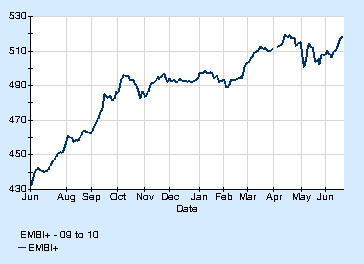
EMBI+ bond index 2010
As far as forex investors are concerned, the confidence in EM capital markets should also extend to currencies. The carry trade is heating up (thanks to the cheap Euro), and will probably only expand as EM Central Banks move to raise interest rates to combat inflation, as alluded to above. If the Eurozone debt crisis intensifies, then you can expect some kind of pull-back. As with recent retracements, however, it will be only temporary.

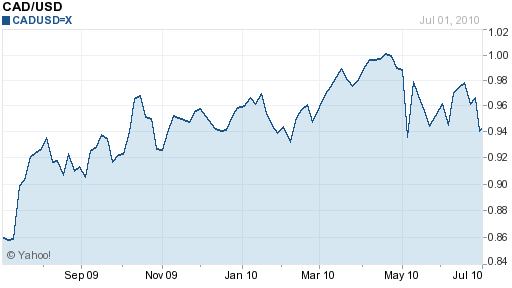
Markets Confused about Canadian Dollar

On a trade-weighted basis, the Canadian Dollar (aka Loonie) has appreciated nearly 10% in 2010. At the same time, it has fallen 8% against the Dollar since the beginning of May. This contradiction is reflected in an explosion in volatility: “CAD has been very volatile – the average intraday spread between the high and low in CAD over the last 21-years has been 83 points; over the last month it has been 182 points.” How can we make sense of this uncertainty, and which trend is ultimately more representative?

CAD USD 1yr

On the one hand, the Loonie continues to be thought of as a commodity currency whose rise and fall is closely linked to fluctuations in the prices of certain raw materials. “It’s not just about oil any more, but also natural gas – whose price has carved out a bottom – and precious metals, which command a 13-per-cent share of the TSX’s market cap versus less than 1 per cent for the S&P 500,” observed one analyst. From this standpoint, it’s perhaps not surprising that a 7.2% drop in the Raw Materials Index was matched by a proportional drop in the value of the Loonie.

On the other hand, the Loonie is being punished by the Eurozone debt crisis and the consequent flight to safe haven currencies: “The Canadian dollar is following the risk aversion tones of the market.” While the Loonie might have otherwise been “been closer to parity” then, it’s understandable that the so-called “panic trade” is holding it down.

In light of the Eurozone debt crisis, however, one might have predicted that commodity currencies would rally, since they are perceived as being backed by something more tangible than government fiat. In fact, some analysts believe that the comparatively modest decline in the Loonie implies that this is indeed the case: “It was fascinating to see the Canadian dollar only correct down to 92 cents during this most recent round of global financial turbulence and flight-to-safety. That is a far cry from the correction down to 78 cents following the Lehman aftershock, not to mention the move down to 62 cents after the tech wreck a decade ago.”

The same analyst pointed out that the notion of the Canadian Dollar as a safe-haven currency is further justified by Canada’s strong fiscal condition. It is trimming its spending, cutting taxes, and may even reduce its national debt. Meanwhile, it’s financial system remains robust, as evidenced by the fact that none of its banks have required government bailouts. Thus, Canadian sovereign debt has continued to appreciate in spite of the crisis across the Atlantic. In short, “The federal government actually deserves the triple-A credit rating that it receives on its debt.”

Going forward then, the near-term performance of the Loonie will depend both on the EU sovereign debt crisis and commodities prices, which in turn are high sensitive to (perceptions of) the global economy. In this latter aspect, there is tremendous uncertainty. The Canadian economy did grow at 6% last quarter. However, “The fear is that weaker U.S. data is posing a risk to the Canadian economy. And the G-20 is really focused on fiscal restraint as opposed to supporting growth. That probably isn’t good for the growth currencies.”

Furthermore, there are implications for the Bank of Canada, which has already embarked on a tightening of monetary policy. It raised its benchmark interest rate – becoming the first industrialized economy Central Bank to do so – to .5% in June, and there is a 45% chance that it will do so again in July. The futures markets are currently pricing in a benchmark rate of 1.25% by year end. Ultimately, “The extent and timing of any additional withdrawal of monetary stimulus would depend on how the outlook for economic activity and inflation evolves.”

For now, interest rate hikes are largely beside the point as investors remain firmly focused on the EU fiscal crisis: “People are taking risk off heading into the summer, to reassess,” summarized one trader. A resolution of the crisis, would surely send the Loonie back towards parity. In the interim, Canada’s strong fundamentals will ensure that it won’t fall much further, poised to strike when the time comes.


Affordable SEO | SEO Experts | SEO Specialist | SEO Packages | Best SEO India