“Investors” Shouldn’t Worry about the Euro

With today’s post, I want to take off my currency trader hat and put on my investor hat.

You might be tempted to argue: But wait, these two aren’t mutually exclusive. Isn’t it possible to wear both hats? While it’s theoretically plausible for a trader to take a long-term view of the markets based on fundamental analysis, I don’t think it’s likely in practice. In the end, a good investor will always have a longer time horizon than a good currency trader. In short, someone who bought shares in Apple 20 years ago is now probably a millionaire. Someone who went long the USD 20 years ago has probably since lost his investment due to inflation.

But seriously, currency traders must adapt to the zero-sum nature of forex markets by shortening their time horizon. Stock market investors, on the other hand, are not bound by this constraint. In fact, by holding stocks for a long enough time period, investors can actually turn this into an advantage.

As a result of the Eurozone sovereign debt crisis, for example, some analysts are calling for foreign (i.e. not using Euros) investors to dump their European. investments. This recommendation is not necessarily a dismissal of European companies (though an argument could be made on this basis as well), but rather is a reflection of concerns that returns will be negatively impacted by the declining Euro. Since foreigners can only purchase shares using their home currencies indirectly (through ADRs and ETFs), they feel the effects of currency fluctuations every time they enter and exit a position. Those that entered into a position prior to the Euro’s decline, by extension, will naturally be hurt if they try to exit before the Euro has had a chance to recover.

But therein lies the problem with this approach. Those that dump their shares now solely over exchange rate concerns are simply locking in their losses, just like American stock market investors who sold their stocks in March 2009 when the DJIA was below 7,000. By instead waiting a year (or longer!) such investors could have at least partially neutralized the impact of these crises. Of course, if recovery in the Euro was perceived as inevitable, then portfolio investors naturally wouldn’t think about divesting from EU capital markets. The concern is that the Euro will continue to decline, perhaps to the point of breakup.

I don’t want to dig myself into a hole by making a 5-year prediction for the Euro, especially since there is a part of me that is concerned that it will continue to decline. Based on history, however, there is very little reason to believe that will be the case. I’m not talking about economic fundamentals – about how the US fiscal position is equally precarious and how currency markets might recognize this and turn on the Dollar – but rather about the nature of forex markets.
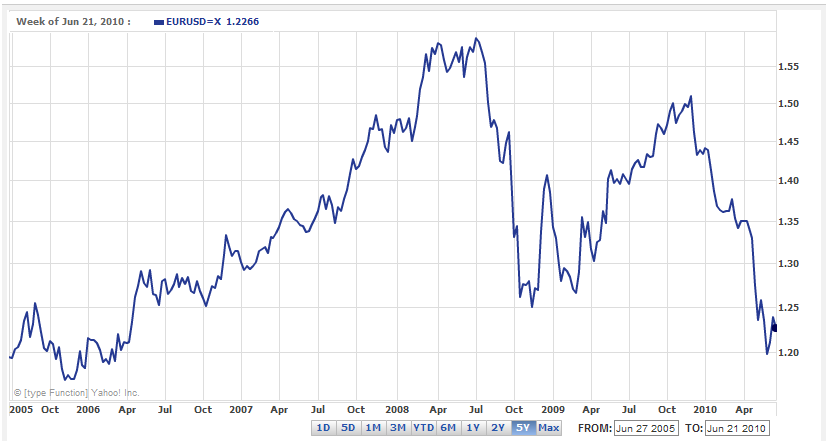
Euro Dollar 5 Year Chart 2005-2010

Simply, currencies fluctuate. Since its introduction 10 years ago, the Euro has fallen, then risen, then fallen, then risen, then fallen again to its current level. If you initially invested in Europe 2 years ago, the exchange rate would erode your returns if you tried to sell now. If you invested 5 years ago, you would break even. If you invested 10 years ago, you would come out ahead. In the end, it’s only a question of perspective. Still, if you maintain your positions for long enough, either you will break-even from the exchange rate or it will only marginally affect your returns (on an annualized basis).

Consider also that you can hedge your exposure to a falling Euro by simply buying Dollars. If you are concerned about exchange rate risk, you can do this every time you open a position. For example, if you were to buy European shares today and simultaneously short an equal quantity of Euros, you would be perfectly hedged against any further decline in the Euro. The cost of the hedge is the sum of any transaction costs, management fees, and negative carry that you incur as part of the currency trade.

In short, unless you deliberately want to speculate on exchange rates, don’t worry about them! If your investing horizon is long enough, their fluctuations will neither help nor hurt you in a meaningful way.

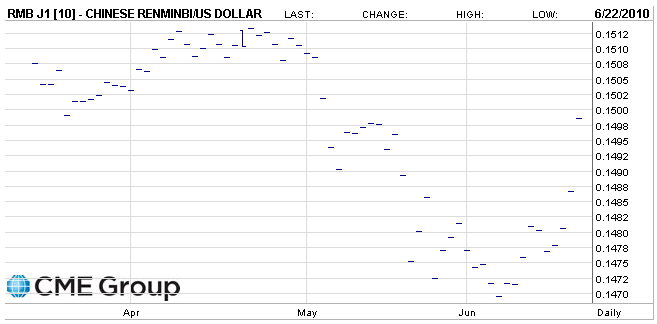
China Revalues RMB….by .4%

It was only last week that I mused about “Further Delays in RMB Revaluation.” Lo and behold, over the weekend, the Central Bank finally budged, by pledging to the members of the G20 that it would ” ‘proceed further with reform‘ of the exchange rate and ‘enhance’ flexibility.” Upon reading this, I suppose I should have felt stupid.

Still, I wondered whether the move was aimed as a political sop designed to appease Western countries, rather than a meaningful change in China’s forex policy. My suspicions were confirmed on Monday, when the markets opened, and the RMB jumped by a pathetic .4%. All of those who had been hoping for an expecting an instant revaluation a la the 5% jump in 2005 were sadly disappointed.

Most commentators shared my cynicism about the move. According to Goldman Sachs Group Chief Global Economist Jim O’Neill, ” ‘It’s pretty astute timing. The timing of it is clearly aimed at the G-20 meeting, which indirectly links to the whole renewed thrust in Congress with protectionist steps against China.’ ” If this was in fact China’s intention, it backfired, since it only succeeding only in bringing increased attention to the still-undervalued Yuan. Senator Sherrod Brown called the appreciation ” ‘a drop in a huge bucket….We’ve seen China take actions like this before when the spotlight is on, and then revert back to old tricks.” Thus, he and Senator Charles Schumer have announced that they will move forward with a bill to punish China, unless the RMB is allowed to significantly appreciate.

By the Central Bank of China’s own admission, this is unlikely. Instead, it will continue to “keep the renminbi exchange rate at a reasonable and balanced level of basic stability.” In other words, the RMB is still pegged squarely to the US Dollar. It is neither freely floating nor is it pegged to a basket of currencies (in which case it could conceivably appreciate faster against the Dollar, due to the weak Euro). It is technically allowed to rise and fall on a daily basis within a .5% ban, but even this is controlled tightly by the Central Bank, via the so-called Central Parity Rate. If the rate fluctuates too much, state-owned companies often intervene in the markets at the behest of the Central Bank. Legitimate market participants are heavily constrained by a rule that requires them to square all of their positions at the end of every trading session, such that making long-term bets on the RMB’s appreciation would be impossible.

RMB Revaluation Chart June 2010
Not that it matters. In the US, where it is legal to make long-term bets on the RMB (via futures contracts), investors are still only projecting a 1.8% appreciation (2.2% relative to the RMB’s pre-revaluation level) over the next year, and a 2.9% appreciation by the end of 2011. In the end, there just isn’t a lot of confidence that China will voluntarily act in a way that is contrary to its own short-term economic interests.

To be sure, there is a possibility that the RMB will be allowed to steadily appreciate, in which case there would be real implications for other financial markets. If the past is any consideration, however, the RMB will rise only modestly against the Dollar, and even more modestly on a trade-weighted basis. Its economy will remain overheated and imbalanced, and if it was headed towards collapse prior to this latest change, it certainly still is.

SNB Abandons Intervention

The Swiss National Bank (SNB) has apparently admitted (temporary) defeat in its battle to hold down the value of the Franc. ” ‘The SNB has reached its limits and if the market wants to see a franc at 1.35 versus the euro, they won’t be able to stop it.’ ” The markets have won. The SNB has lost.

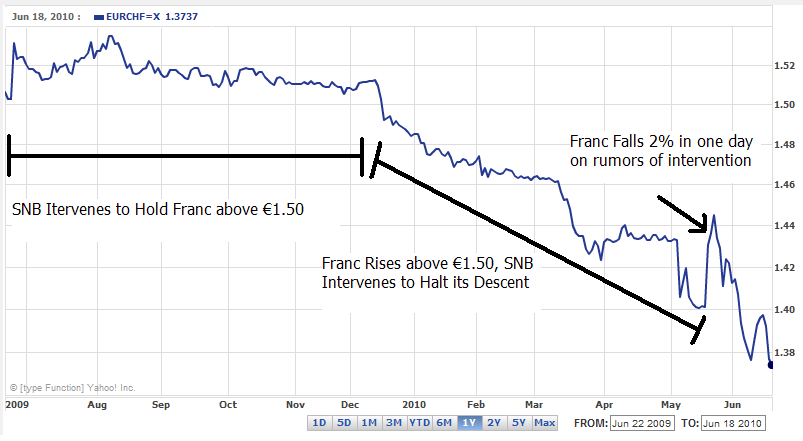
SNB Franc Intervention Chart - 2009-2010
Still, the SNB should be applauded for its efforts. As you can see from the chart above, it managed to keep the Franc from rising above €1.50 (its so-called line in the sand) for the better part of 2009. Furthermore, by most accounts, it managed to slow the Franc’s unavoidable descent against the Euro in 2010. While the Dollar has appreciated more than 15% against the Euro, the Franc has a risen by a more modest 10%. ” ‘Without that €90 billion [intervention], it’s fair to say that the euro would be closer to $1.10,’ ” argued one analyst. In fact, as recently as May 18, the SNB manifested its power in the form of 1-day, 2% decline in the Franc, its sharpest fall in more than a year.

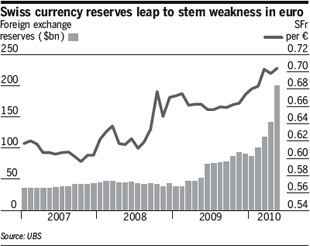
Overall, the SNB has spent more than $200 Billion over the last 12 months, including $73 Billion in the month of May alone. ” ‘To put the figures in perspective, there have been only two months when China, the world’s largest holder of forex reserves with $2,249bn in assets, saw its reserves increase more.’ ” The SNB now claims the world’s 7th largest foreign exchange reserves, ahead of the perennial interveners of Brazil in Hong Kong, the latter of whose currency is pegged against the Dollar.

Swiss SNB Forex Reserves - Intervention
While the SNB can take some credit for halting the decline in the Franc, it was ultimately done in by factors beyond its control, namely the Eurozone sovereign debt crisis and consequent surge in risk aversion. At this point the forces that the SNB is battling against are too large to be contained: “We’re talking about a massive euro crisis, so no single central bank can prop it up on its own,” summarized one trader. As a result, the Franc is now rising to a fresh record high against the Euro nearly every trading session.

Still, the SNB remains committed to rhetorical intervention. “The central bank has a ‘clear aim‘ to maintain price stability and this is what guides its policy actions, SNB President Philipp Hildebrand said…The bank will act in a ‘decisive manner if needed.’ ” That means that if economic growth slows and/or deflation sets it, it may have to restart the printing presses. Given that its economy is slated to grow at a solid 1.5% this year, unemployment is a meager 3.8%, and the threat of inflation has largely abated. On the other hand, the prospect of a drawn-out crisis in the EU means the Franc will probably continue to appreciate – without help from the Central Bank: ” ‘The SNB may continue to intervene in the currency markets until 2020,’ ” declared the head of forex research for UBS.

The implications for currency markets are interesting. Not only has the SNB prevented the Euro from falling too fast against the Franc, but it may also have prevented it from falling too quickly against other currencies. ” ‘To suggest that the SNB has been the savior of the euro is too much. But one could imagine that if the euro starts to decline again, the market may blame the fact that the SNB isn’t buying,’ ” said a currency strategist from Standard Bank.

This episode is also a testament to the limits of intervention. It has always been clear (to this blogger, at least) that intervention is futile in the long-term. The best that a Central Bank can hope for is to stall a particular outcome long enough in order to achieve a certain short-term policy aim. When enough momentum coalesces behind a (floating) currency, there is nothing that a Central Bank can do to stop it from moving to the rate that investors collectively deem it to be worth.

Scared of the Weekend?

In what has become a familiar pattern, Friday selling of risk assets heading into the weekend is taking place as the risk posed by the Euro zone debt crisis is still prevalent. In fact, various policy makers around the globe have expressed concern about the Euro zone, even as the market has been in risk-taking mode as of late.

Today there is a lack of market making news so we’ll turn our attention to more macro themes, one of them being oil prices. It was only a matter of time before fallout from the oil spill in the US began to show up in the markets. The proposed ban on offshore drilling will only reduce supply, thereby causing prices to move higher. The cruel irony is that this would actually benefit BP, the company responsible for this disaster. That means higher prices for consumers.

This is also falls in line with yesterday’s discussion of biflation, where we are likely to see higher commodity prices yet debt-based asset prices go lower.

If the usual correlations hold up, this will benefit the Canadian dollar the most, and the US dollar the least. It’s amazing to think that even in the face of nascent recovery, that oil prices are around $75/barrel. What would it be if we were in full-blown recovery mode? Conspiracy theorists will tell you that high oil prices increase the demand for alternative energy, one of the largest pieces of the Obama agenda. Now I’m not a conspiracy theorist, however I believe in “cui bono”, meaning who stand to benefit the most. You decide for yourself.

So this morning we’re seeing some mild risk aversion, as traders wish to avoid weekend risk from the Euro zone.

In the forex market:

Aussie (AUD): Risk aversion is pushing the Aussie slightly lower going into the weekend. If commodity inflation persists, higher gold prices would benefit the Aussie.

Kiwi (NZD): Same as the Aussie though slightly lower following the “risk ladder”.

Loonie (CAD): The Loonie is lower as oil prices have pulled back as there is concern over the pace of global recovery. In addition the BOC said that there are no “pre-ordained” rate hikes, leaving the door open for a possible pause.

Euro (EUR): The Euro is lower as the ECB head maintained that rates were appropriate in light of the debt situation in the region. However, German PPI figures came in higher than expected, showing signs that inflation may be heating up in the Euro zone’s largest economy.

Pound (GBP): The Pound has given back overnight gains that pushed it to 1,4885 vs. USD. Next Tuesday, the government will release its budget statement that is expected to show a significant deficit and major cost-cutting measure to combat that problem. So far, the market has reacted favorably to the plan as the Pound has had recent gains.

Dollar (USD): The Dollar is slightly higher on risk-aversion, as traders use the safe-haven aspects as a temporary holding vessel.

Yen (JPY): Consumer lending and bank stocks fell on the Nikkei taking the index lower and causing a rise in Yen. In addition, the BOJ is concerned about the Euro zone debt crisis spreading to Japan according to it rate policy meeting’s minutes.

On a day that is light on news, the markets may not tend to move much. As of right now, the market is largely unchanged, with a slight bias toward risk-aversion.

This just goes to show that the daily news events that occur around the globe really do have an impact on the currency and other financial markets. While one doesn’t need to be an expert economist to understand why things move as they do, it is important to know if there is news for a specific currency you like to trade.

And that is the purpose of this blog; to give readers a brief run-down of what’s happening so that they may be aware of potential drivers or obstacles to their favorite currency pair.

So I expect today to be a quiet one, with the start of the summer season picking up as the market slows. In fact, I am on a long vacation weekend myself!


Affordable SEO | SEO Experts | SEO Specialist | SEO Packages | Best SEO India