The Trend is Your Friend

Raise your hand if you’ve ever heard that expression before? Well, now there’s proof that this well-worn phrase is more than just a pointless platitude: “Royal Bank of Scotland Group indexes that track the performance of four of the most popular currency strategies show that the so-called trend style was the best-performing method, returning 7.3 percent this year through August.”

“Trend-Style” trading is also known as trend-following, and is just as it sounds. Traders identify one-way patterns in specific currency pair(s), and attempt to ride them for as long as possible. Given all of the big movements in currency markets this year, it’s no wonder that trend-following is the most popular. If you look at the 52 week trading ranges for the six most popular USD currency pairs, you can see that highs and lows are often as far as 20% apart. The EUR/USD pair, for example, fell 20% over a mere 7 months. Anyone who sold in December 2009 and bought to cover in June 2010 would have earned an annualized return of 35% without leverage! Even if you had captured only a couple months of depreciation would have yielded impressive returns. In addition, you could have traded the Euro back up from June until August and reaped a 60% annualized return. Best of all, both of these trends (down, then up) unfolded very smoothly, with only minor corrections along the way.
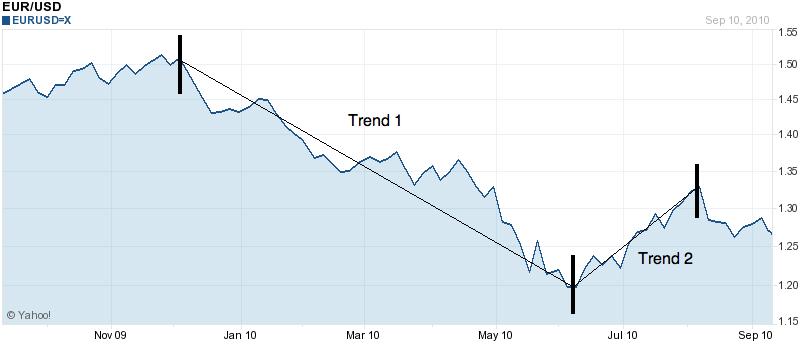
The Trend is Your Friend- USD/EURI’m sure serious technical analysts are rolling their eyes at the chart above, but the point stands that trend-following has never been easier and rarely more profitable than it is now. One fund manager summarized, “Trend-following investors are capturing the momentum in several big currency moves. You have so much uncertainty in the world now with regard to inflation or deflation, which typically makes currency markets and interest rates move. That is good for trend followers as it causes volatility, which typically creates good profits.” In other words, there is a tremendous amount happening in forex markets at the moment, and this is reflected in protracted, deep moves in currency pairs, which can change direction without notice and yet continue moving the opposite way for just as long. If you think this sounds obvious, look at historical data (5-10 years) for the majority of currency pairs: while trends have always been abundant, it was only recently that they began to last longer and became more pronounced.

The other three strategies surveyed by the Royal Scotland Group (”RSG”) were theCarry Trade, Value Trade, and Volatility Trade. Unfortunately, data was only offered for the carry trade strategy (confusingly referred to by RSG as the volatility strategy), which is down 5.9% in the year-to-date. The carry trade strategy involves selling a currency with a low yield and favor of one with a high yield, and profiting from the interest rate spread. In order for this strategy to be profitable, however, the long currency must either appreciate or remain constant. Thus, when volatility is high – as it has been over the last 2-3 years – this is a losing strategy.

We can only guess that a true volatility strategy probably would have been the second most profitable strategy. This strategy can be implemented through the use of long and short spot positions, as well as through trading in options and other derivatives. As I said, there is no shortage of volatility at the moment: “Since the collapse of Lehman Brothers in 2008, the dollar has seen record volatility against the euro…including six moves of at least 10%.” For traders that profit from volatility, the current uncertainty has created a windfall situation.

Getting Better, But Not There Yet!

This morning, US initial jobless claims came in better than expected showing 451K new claims vs. an expectation of 470K. While this is a step in the right direction, it is still at unacceptably high levels and may remain there for some time unless we get a shift in government policy.

Earlier in the morning, the BOE maintained current monetary policy as was expected, so recent signs that inflation concerns may be rising will be revealed from the monetary policy meeting minutes due out in about two weeks. The pound is weaker as a result.

Overnight, the Australian employment change came in better than expected as well, reporting a gain of 31K vs. an expectation of 25K.

So the market is in a bit of risk-taking mode to start the day, led by the commodity currencies and the Euro.

In the forex market:

Aussie (AUD): The Aussie is higher as risk appetite has returned to the market this morning. Better than expected employment figures have increased demand as the Australian economy still appears to be operating on all cylinders, with the jobless rate at 5.1%.

Kiwi (NZD): The Kiwi is higher on risk taking despite the fact that home prices increased at their slowest pace as consumer borrowing declined as home interest rates increased. In addition, weaker manufacturing figures showed that growth may be slowing.

Loonie (CAD): The Loonie is also higher falling in line with risk themes and its appropriate place in the risk hierarchy. Providing an additional bid is higher oil prices, which have increased to 75.50. However, housing starts came in less than expected and the Canadian trade deficit widened to the largest levels on record, as lack of US demand hurt exports.

Euro (EUR): The euro is mixed today under classic risk-taking scenarios. The market is brushing off “news” that comments from an ECB member claimed that German banks are also under-capitalized. In Germany, CPI data came in slightly better than expected, though still showing that inflation is tame.

Pound (GBP): The Pound is lower across the board as the BOE maintained monetary policy as expected. In addition, the UK trade balance figures showed a wider than expected trade deficit, most likely the result of recent Pound strength.

Dollar (USD): The Dollar is mostly lower, including against the Yen as US stocks are higher after the “encouraging” initial jobless claims figures.

Yen (JPY): The Yen is mostly lower, though posting slight gains against the Pound and Dollar. Overnight, consumer confidence figures came in lower than expected and tonight Japanese GDP figures are expected to show growth of .4% for the quarter, with the annualized figure at 1.5%. However, the huge story is still over Yen intervention, and the market appears to be testing government resolve.

Today’s initial jobless claims figures are giving the bulls a reason to push markets higher despite the fact the figure is still bad by historical standards. I guess you have to take your small victories where you can get them.

Meanwhile, in the UK the BOE appears to be discounting inflation concerns in favor of hoping to encourage further growth.

I’m becoming very skeptical of news coming out of the EU regarding the debt crisis as it seems to be a convenient way to attempt to keep the Euro low to help encourage exports. Until action is needed and a problem occurs, I am content to remain positive that the ECB will handle it.

The commodity currencies keep chugging along as those economies appear to be doing better than the more established ones.

And lastly all eyes are on Japan as the intervention talk heats up with every day’s Yen appreciation vs. the Dollar.

To learn more about how you can take advantage of world events through the currency market, be sure to check out our currency trading courses!

CFTC Passes New Retail Forex Guidelines

have been covering the US Commodity Future Trading Commission’s (CFTC) efforts to revamp the regulatory structure that governs forex, since it was unveiled earlier this year. On August 30, the CFTC formally published the “final regulationsconcerning off-exchange retail foreign currency transactions. The rules implement provisions of the Dodd-Frank Wall Street Reform and Consumer Protection Act and the Food, Conservation, and Energy Act of 2008, which, together, provide the CFTC with broad authority to register and regulate entities wishing to serve as counterparties to, or to intermediate, retail foreign exchange (forex) transactions.”

Not only has the CFTC clearly established its authority to be the primary regulator of retail forex, but it has also laid out specific regulations. Chief among them is limiting leverage to 50:1 for major currency pairs, and 20:1 for “other retail forextransactions.” [It's not presently clear which specific currency pairs will be classified as major]. Remember that the original proposal (which, along with my endorsement, generated vehement protest) called for a decline in leverage to 10:1. Due to negative feedback from traders and brokerages, which ascribed malicious political motives to the changes and argued that it would move the entire industry offshore, the CFTC backed down and implemented only a modest decline in leverage. However, it’s important to note that the National Futures Association (NFA) as well as individual brokers will have discretionary power in setting leverage limits lower than 50:1. There will undoubtedly still be some opposition from traders, but I think we can all agree that the new rule represents a fair compromise.

As for the claim that traders would/will move their accounts offshore, this will become largely moot, since all brokerages, regardless of nationality, will be required to register with the CFTC and subject to its rules/oversight. Of course, those traders that are so inclined will still find a way to circumvent the rules by shifting funds “illegally” to unregistered brokers, but they do so at their own risk and will have no recourse in the event of fraud. As Forbes noted, “It seems these new rules will put a stop to Americans trading retail forex offshore to evade CFTC rules. That trend picked up the pace in recent years and it may need to be reversed quickly.”

Brokerages must register as either futures commission merchants (FCMs) or retail foreign exchange dealers (RFEDs). These institutions will be required to “maintain net capital of $20 million plus 5 percent of the amount, if any, by which liabilities to retail forex customers exceed $10 million.” While this rule will raise the barriers to entry for potential forex start-up brokerages, it will protect consumers against broker bankruptcy. In addition, “Persons who solicit orders, exercise discretionary trading authority or operate pools with respect to retail forex also will be required to register, either as introducing brokers, commodity trading advisors, commodity pool operators (as appropriate) or as associated persons of such entities.”

One final rule change worth noting is quite interesting: brokerages must “disclose on a quarterly basis the percentage of non-discretionary accounts that realized a profit and to keep and make available records of that calculation.” This calculation will be useful both in and of itself, and also in identifying any significant discrepancies between competing brokers. For the first time, we will be able to see whether forextrading is currently profitable (i.e. whether those that profit are in the majority or minority) and whether/how this profitability metric changes over time, in response to particular market conditions.

Weighing Risk in Forex Positions

When opening a Forex position it’s very important to consider your own maximum risk tolerance, which usually depends on the account size and the stop-loss of the said position. Risking only a small fixed fraction of your account balance is a nice way to limit your losses and to organize the whole trading process. But there is also another risk factor that’s often overlooked by the traders and is rarely used when opening a new position — a risk of trade (or its success probability).

A risk of trade can be measured as the expected success rate of the position. For example, if you saw Fed raising interest rate unexpectedly it’s almost a surefire bet (with about 90% probability) that the USD will go up at least slightly. Position based on this signal can be characterized as the low-risk one. And if (for example) usually you risk about 1% of your capital per each trade, for this position you could increase its size to risk, let’s say, 2%. For the opposite example, let’s presume that you are trying out some new Forex signal service and consider that relying on it is quite risky. So, the usual 1% of the initial capital risk can be reduced to 0.5%.

The problem with this risk of success is that it’s very subjective and there is no good way to measure it precisely. A trader would need to rely on his experience and intuition to weigh the risk into his positions. But some approximate system of risk weighing can be organized even by rather new Forex traders and the result of its implementation would be quite nice.

So, next time when you see a nice signal and go to some position size calculator (or even if you do it manually), consider evaluating a probability of trade’s success and alter the position size accordingly.

Australia Dollar Ebbs and Flows with Risk

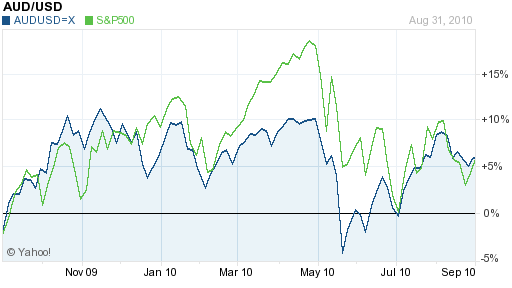
If you chart the course of the Australian Dollar over the last twelve months alongside the S&P 500, the overlap is jarring. You can see from the chart below that the two lines zig and zag in almost perfect unison. It would seem that there was a slight break in the second quarter of 2010, but even this is an illusion, since the Aussie and the S&P continued to rise and fall in the same patterns over that time period, differing only in degree of fluctuation.

Australian Dollar Versus S&P 500: 2009-2010
Since the S&P 500 is a pretty good proxy for risk it can be said that the Australian Dollar is a manifestation of investor risk appetite. When risk aversion was high, the S&P and the Aussie were low. When risk tolerance picked up, they rose. It’s funny how this came to be. It is probably best seen as a vestige from the credit crisis, whereby investors evenly divided assets into two classes: risky and safe. When you look at the performance of the Australian Dollar, it is pretty clear as to which side of the dividing line it was placed.

This is probably fair, since the Australian Dollar is a growth currency. According to the just-released Bank of International Settlements (BIS) Triennial Central Bank Survey of Foreign Exchange and Derivatives Market Activity, the Australian Dollar is now the world’s fifth most traded currency (behind only the G4: Dollar, Euro, Yen, & Pound), having usurped that position from the Swiss Franc. In 2010, it accounted for 7.6% (out of a total of 200%) of all trading volume, primarily as a result of trading in the USD/AUD currency pair, which was the fourth most popular in forex.

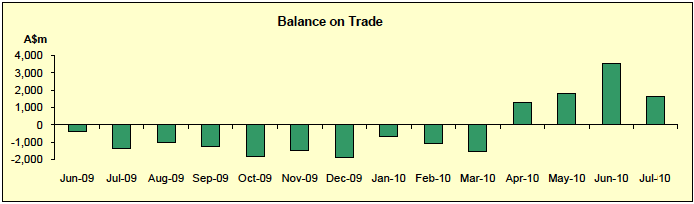
Investors have come to see the Australian Dollar in somewhat contradictory terms. It is both stable and liquid, but its economy is unpredictable and inflation is usually above average. The current economic situation was strong, with GDP growth projected to exceed 3% in 2010. Its benchmark interest rate (4.5%) is the highest in the industrialized world, and may touch 5% before the year is over. On the other hand, its political situation is currently uncertain, thanks to an election that produced a hung Parliament and the recent resignation of its Prime Minster. In addition, while its trade balance is currently in surplus, it fell in July thanks to decreased demand from China. Analysts wonder whether it isn’t entirely dependent on China (directly via exports and indirectly via high commodity prices) to generate positive GDP growth.

Australia Balance of Trade - 2009- July 2010
Ultimately, investors don’t care about any of this. They care only whether the global economy is stable and whether another financial/credit/economic crisis is likely to occur. Even though any such crisis will probably spare Australia, the Aussie is punished by even the whiff of crisis because Australia is perceived as being riskier to invest than the US, for example. “The Australian dollar is going to stay heavy. Markets don’t like uncertainty,” summarized JP Morgan.

Sadly, it’s currently not worth parsing the nuances of trade statistics and monetary policy, because it has no bearing on the Aussie, though at least this makes my job easier. For the time being, the Australian Dollar will tick up if it looks like the global economy (principally the US) will avoid a double-dip recession. Otherwise, it is in for the same rough stretch as the S&P.

Trading In Emerging/Exotic Currencies Increases

The long wait is over! The Bank of International Settlements (BIS) has just released the results from its Triennial Central Bank Survey of Foreign Exchange and Derivatives Market Activity, conducted in April 2010. The report contains a veritable treasure trove of data, perhaps enough to keep analysts busy until the next report is released in 2013. [Chart below courtesy of WSJ.

Daily Turnover in Forex Markets

First, the data confirmed earlier reports average daily forex volume had surged to a record level in 2010: “Global foreign exchange market turnover was 20% higher in April 2010 than in April 2007, with average daily turnover of $4.0 trillion compared to $3.3 trillion. The increase was driven by the 48% growth in turnover of spot transactions, which represent 37% of foreign exchange market turnover. The increase in turnover of other foreign exchange instruments [consisting mainly of swaps and accounting for the majority of forex trading activity] was more modest at 7%.” In addition, for the first time, investors and financial institutions accounted for a larger share of turnover than banks, whose trading activity has remained roughly unchanged since 2004.

The composition of the turnover actually didn’t change from 2007, interrupting a shift which had been taking place over the previous 10 years. Specifically, the share of overall turnover accounted for by the so-called major currencies actually increased in 2010, from 172% to 175%. [Since there are two currencies in every transaction, total volume sums to 200%]. Growth in the G4 currencies (Dollar, Euro, Pound, Yen) was more modest, however, increasing from 154% to 155%. This reversal is probably attributable to the credit crisis, which drove (and in fact, continues to drive) investors out of emerging market currencies and back into safe haven currencies, namely the Dollar, Yen, and Pound. However, this theory is belied by the significant increase in Euro trading activity, which certainly hasn’t benefited from the recent trend towards risk aversion.

Forex Composition, Major Currencies Versus Emerging Currencies

While emerging currencies as a group accounted for a smaller share of overall activity, certain individual currencies managed to increase their respective shares. The Singapore Dollar, Korean Won, New Turkish Lira, and Brazilian Real all fit into this category. Still other currencies, such as the Indonesian Rupiah and Malaysian Ringgit, also managed impressive gains but account for such a small share of volume as to be insignificant when looking at the overall the picture. Those who were expecting even bigger growth should remember that it’s ultimately a numbers game: the amount of Ringgit it outstanding is dwarfed by the number of Dollars, so any gains that the Ringgit can eke out are impressive. In addition, when you consider that the overall forex pie is also increasing, the nominal increase in volume for these small currencies was actually quite large.

Growth in Emerging Currencies Forex Volume
The ongoing search for yield in all corners of the financial markets is likely to bring some of the more obscure currencies into the fold. “In June, I began getting questions about Uruguay, Vietnam and others,” said Win Thin, senior currency strategist at Brown Brothers Harriman in New York…investors often asked Mr. Thin questions about less-familiar currencies such as the Ukrainian hryvnia and Romanian leu.” In the same article, however, Mr. Thin cautioned that interest in such currencies is still probably lower than in 2007-2008, for a good reason. “It’s not like the Group of 10, or even the more liquid emerging market currencies where, if you decide you’ve made a mistake, you can get out.”

Due to the lack of liquidity these obscure currencies aren’t really suitable for trading. Of course there will be a handful of institutional and even retail investors that want to make long-term bets on these currencies. They tend to be more aware of the risk and less sensitive to the higher cost and lower convenience. The overwhelming majority of traders, however, churn their portfolios daily, if not hundreds of times per day. A 10pip spread on the USD/MXN (Dollar/Mexican Peso) would be considered too high, let alone a 50 pip spread on any transaction involving the Ukrainian hryvnia.

In short, the majors will account for the majority of trading volume for the foreseeable future, regardless of what happens to the Euro. At the same time, that won’t prevent a handful of selected emerging currencies, such as the Chinese Yuan, Indian Rupee, Brazilian Real, and Russian Ruble from increasing their share. As liquidity rises and spreads decline, volume will increase, and their rising importance will become self-fulfilling.

Emerging Markets Rally, Despite Eurozone Debt Crisis

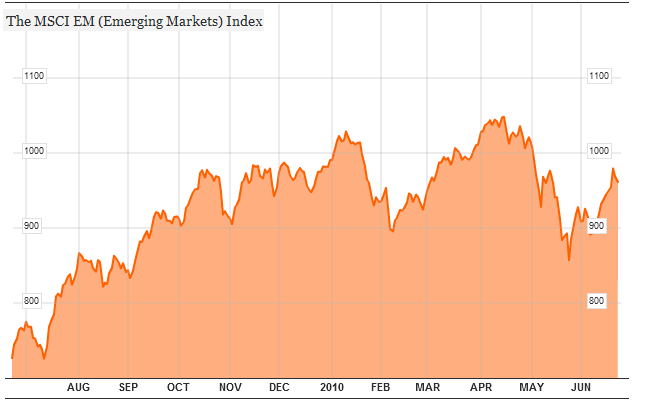
It looks like emerging market investors took my last post (“Investors” Shouldn’t Worry about the Euro) to heart, since emerging markets (EM) have continued to rally in spite of the Euro’s woes. To be sure, EM stocks, bonds, and currencies all dipped slightly in May when the crisis reached fever pitch, but they have since recovered their losses and are once again en route to record highs.

MSCI Stock Index 2010

That’s not to say that that surge in risk-aversion wasn’t justified. In fact, investors are continuing to punish the Eurozone as well as a handful of other risky areas. However, analysts have concluded that in the case of emerging markets as a whole, this mindset doesn’t really make sense.

Simply, the fiscal and economic condition of is stronger than in developing countries. Whereas previously crises were known to originate in developing countries and spread to industrialized countries, this latest series of crisis turned that notion on its head. The credit and housing crises were largely the product of speculation in the West, and the sovereign debt crisis originated in Europe. While it’s possible that investor concern would self-fulfillingly cause the crisis to spread to emerging markets, any impact would probably be muted.

There is recognition that emerging market balance sheets are strong and the debt to GDP ratio is below 40 per cent compared to the western world, where it is over 100 per cent in many countries,” summarized one analyst. “The vast majority of emerging market countries ‘have the tools to tackle inflation and will succeed, having reasonable independence from their central banks,’ ” added another.

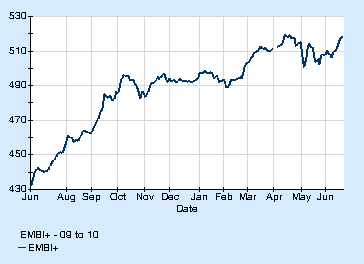
Thus, the funds continue to pour in. “Net inflows into emerging market debt totalled $30.6bn (£20.7bn, €25bn) from the beginning of the year to late May compared with $33bn for the whole of 2009.” Here’s another sign of EM confidence: “IPOs in developing countries raised $29.3 billion this quarter, almost three times the amount in industrialised nations.” Meanwhile, the MSCI Emerging Market Stock Index has just finished its strongest rally since 2005, and the JP Morgan Emerging Market Bond Index (EMBI+) is closing in on another record high. This is frankly incredible when you consider that around half of the countries with the largest weightings in the index have experienced debt crises of varying severity over the last decade.

EMBI+ bond index 2010
As far as forex investors are concerned, the confidence in EM capital markets should also extend to currencies. The carry trade is heating up (thanks to the cheap Euro), and will probably only expand as EM Central Banks move to raise interest rates to combat inflation, as alluded to above. If the Eurozone debt crisis intensifies, then you can expect some kind of pull-back. As with recent retracements, however, it will be only temporary.

Markets Confused about Canadian Dollar

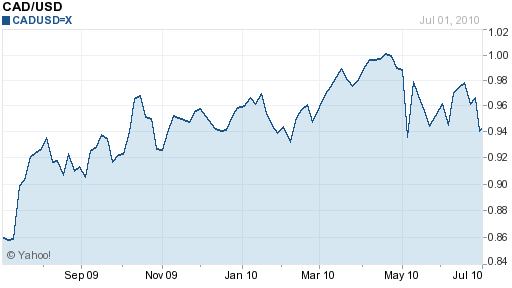
On a trade-weighted basis, the Canadian Dollar (aka Loonie) has appreciated nearly 10% in 2010. At the same time, it has fallen 8% against the Dollar since the beginning of May. This contradiction is reflected in an explosion in volatility: “CAD has been very volatile – the average intraday spread between the high and low in CAD over the last 21-years has been 83 points; over the last month it has been 182 points.” How can we make sense of this uncertainty, and which trend is ultimately more representative?

CAD USD 1yr

On the one hand, the Loonie continues to be thought of as a commodity currency whose rise and fall is closely linked to fluctuations in the prices of certain raw materials. “It’s not just about oil any more, but also natural gas – whose price has carved out a bottom – and precious metals, which command a 13-per-cent share of the TSX’s market cap versus less than 1 per cent for the S&P 500,” observed one analyst. From this standpoint, it’s perhaps not surprising that a 7.2% drop in the Raw Materials Index was matched by a proportional drop in the value of the Loonie.

On the other hand, the Loonie is being punished by the Eurozone debt crisis and the consequent flight to safe haven currencies: “The Canadian dollar is following the risk aversion tones of the market.” While the Loonie might have otherwise been “been closer to parity” then, it’s understandable that the so-called “panic trade” is holding it down.

In light of the Eurozone debt crisis, however, one might have predicted that commodity currencies would rally, since they are perceived as being backed by something more tangible than government fiat. In fact, some analysts believe that the comparatively modest decline in the Loonie implies that this is indeed the case: “It was fascinating to see the Canadian dollar only correct down to 92 cents during this most recent round of global financial turbulence and flight-to-safety. That is a far cry from the correction down to 78 cents following the Lehman aftershock, not to mention the move down to 62 cents after the tech wreck a decade ago.”

The same analyst pointed out that the notion of the Canadian Dollar as a safe-haven currency is further justified by Canada’s strong fiscal condition. It is trimming its spending, cutting taxes, and may even reduce its national debt. Meanwhile, it’s financial system remains robust, as evidenced by the fact that none of its banks have required government bailouts. Thus, Canadian sovereign debt has continued to appreciate in spite of the crisis across the Atlantic. In short, “The federal government actually deserves the triple-A credit rating that it receives on its debt.”

Going forward then, the near-term performance of the Loonie will depend both on the EU sovereign debt crisis and commodities prices, which in turn are high sensitive to (perceptions of) the global economy. In this latter aspect, there is tremendous uncertainty. The Canadian economy did grow at 6% last quarter. However, “The fear is that weaker U.S. data is posing a risk to the Canadian economy. And the G-20 is really focused on fiscal restraint as opposed to supporting growth. That probably isn’t good for the growth currencies.”

Furthermore, there are implications for the Bank of Canada, which has already embarked on a tightening of monetary policy. It raised its benchmark interest rate – becoming the first industrialized economy Central Bank to do so – to .5% in June, and there is a 45% chance that it will do so again in July. The futures markets are currently pricing in a benchmark rate of 1.25% by year end. Ultimately, “The extent and timing of any additional withdrawal of monetary stimulus would depend on how the outlook for economic activity and inflation evolves.”

For now, interest rate hikes are largely beside the point as investors remain firmly focused on the EU fiscal crisis: “People are taking risk off heading into the summer, to reassess,” summarized one trader. A resolution of the crisis, would surely send the Loonie back towards parity. In the interim, Canada’s strong fundamentals will ensure that it won’t fall much further, poised to strike when the time comes.

“Investors” Shouldn’t Worry about the Euro

With today’s post, I want to take off my currency trader hat and put on my investor hat.

You might be tempted to argue: But wait, these two aren’t mutually exclusive. Isn’t it possible to wear both hats? While it’s theoretically plausible for a trader to take a long-term view of the markets based on fundamental analysis, I don’t think it’s likely in practice. In the end, a good investor will always have a longer time horizon than a good currency trader. In short, someone who bought shares in Apple 20 years ago is now probably a millionaire. Someone who went long the USD 20 years ago has probably since lost his investment due to inflation.

But seriously, currency traders must adapt to the zero-sum nature of forex markets by shortening their time horizon. Stock market investors, on the other hand, are not bound by this constraint. In fact, by holding stocks for a long enough time period, investors can actually turn this into an advantage.

As a result of the Eurozone sovereign debt crisis, for example, some analysts are calling for foreign (i.e. not using Euros) investors to dump their European. investments. This recommendation is not necessarily a dismissal of European companies (though an argument could be made on this basis as well), but rather is a reflection of concerns that returns will be negatively impacted by the declining Euro. Since foreigners can only purchase shares using their home currencies indirectly (through ADRs and ETFs), they feel the effects of currency fluctuations every time they enter and exit a position. Those that entered into a position prior to the Euro’s decline, by extension, will naturally be hurt if they try to exit before the Euro has had a chance to recover.

But therein lies the problem with this approach. Those that dump their shares now solely over exchange rate concerns are simply locking in their losses, just like American stock market investors who sold their stocks in March 2009 when the DJIA was below 7,000. By instead waiting a year (or longer!) such investors could have at least partially neutralized the impact of these crises. Of course, if recovery in the Euro was perceived as inevitable, then portfolio investors naturally wouldn’t think about divesting from EU capital markets. The concern is that the Euro will continue to decline, perhaps to the point of breakup.

I don’t want to dig myself into a hole by making a 5-year prediction for the Euro, especially since there is a part of me that is concerned that it will continue to decline. Based on history, however, there is very little reason to believe that will be the case. I’m not talking about economic fundamentals – about how the US fiscal position is equally precarious and how currency markets might recognize this and turn on the Dollar – but rather about the nature of forex markets.

Euro Dollar 5 Year Chart 2005-2010

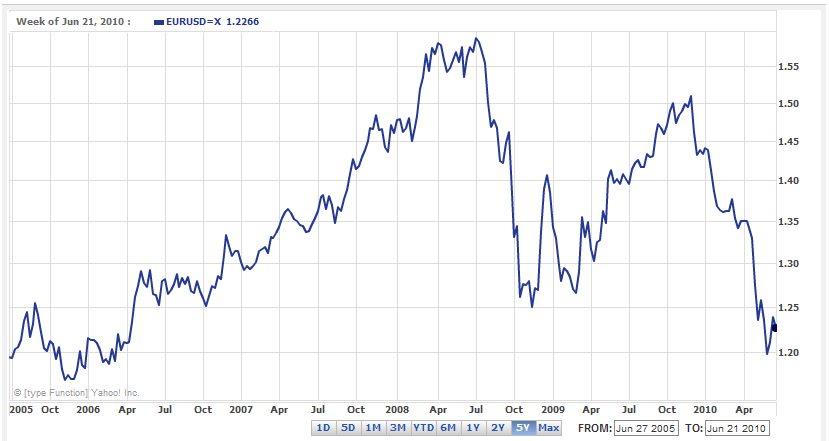
Simply, currencies fluctuate. Since its introduction 10 years ago, the Euro has fallen, then risen, then fallen, then risen, then fallen again to its current level. If you initially invested in Europe 2 years ago, the exchange rate would erode your returns if you tried to sell now. If you invested 5 years ago, you would break even. If you invested 10 years ago, you would come out ahead. In the end, it’s only a question of perspective. Still, if you maintain your positions for long enough, either you will break-even from the exchange rate or it will only marginally affect your returns (on an annualized basis).

Consider also that you can hedge your exposure to a falling Euro by simply buying Dollars. If you are concerned about exchange rate risk, you can do this every time you open a position. For example, if you were to buy European shares today and simultaneously short an equal quantity of Euros, you would be perfectly hedged against any further decline in the Euro. The cost of the hedge is the sum of any transaction costs, management fees, and negative carry that you incur as part of the currency trade.

In short, unless you deliberately want to speculate on exchange rates, don’t worry about them! If your investing horizon is long enough, their fluctuations will neither help nor hurt you in a meaningful way.

China Revalues RMB….by .4%

It was only last week that I mused about “Further Delays in RMB Revaluation.” Lo and behold, over the weekend, the Central Bank finally budged, by pledging to the members of the G20 that it would ” ‘proceed further with reform‘ of the exchange rate and ‘enhance’ flexibility.” Upon reading this, I suppose I should have felt stupid.

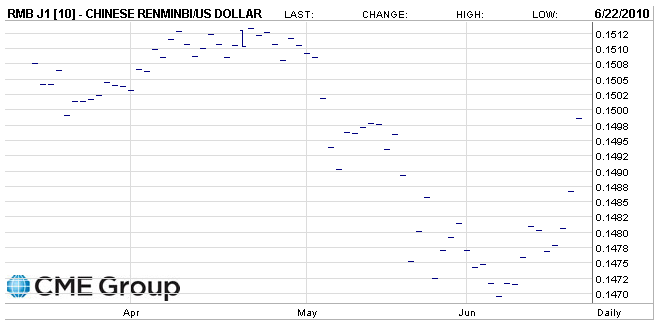
Still, I wondered whether the move was aimed as a political sop designed to appease Western countries, rather than a meaningful change in China’s forex policy. My suspicions were confirmed on Monday, when the markets opened, and the RMB jumped by a pathetic .4%. All of those who had been hoping for an expecting an instant revaluation a la the 5% jump in 2005 were sadly disappointed.

Most commentators shared my cynicism about the move. According to Goldman Sachs Group Chief Global Economist Jim O’Neill, ” ‘It’s pretty astute timing. The timing of it is clearly aimed at the G-20 meeting, which indirectly links to the whole renewed thrust in Congress with protectionist steps against China.’ ” If this was in fact China’s intention, it backfired, since it only succeeding only in bringing increased attention to the still-undervalued Yuan. Senator Sherrod Brown called the appreciation ” ‘a drop in a huge bucket….We’ve seen China take actions like this before when the spotlight is on, and then revert back to old tricks.” Thus, he and Senator Charles Schumer have announced that they will move forward with a bill to punish China, unless the RMB is allowed to significantly appreciate.

By the Central Bank of China’s own admission, this is unlikely. Instead, it will continue to “keep the renminbi exchange rate at a reasonable and balanced level of basic stability.” In other words, the RMB is still pegged squarely to the US Dollar. It is neither freely floating nor is it pegged to a basket of currencies (in which case it could conceivably appreciate faster against the Dollar, due to the weak Euro). It is technically allowed to rise and fall on a daily basis within a .5% ban, but even this is controlled tightly by the Central Bank, via the so-called Central Parity Rate. If the rate fluctuates too much, state-owned companies often intervene in the markets at the behest of the Central Bank. Legitimate market participants are heavily constrained by a rule that requires them to square all of their positions at the end of every trading session, such that making long-term bets on the RMB’s appreciation would be impossible.

RMB Revaluation Chart June 2010
Not that it matters. In the US, where it is legal to make long-term bets on the RMB (via futures contracts), investors are still only projecting a 1.8% appreciation (2.2% relative to the RMB’s pre-revaluation level) over the next year, and a 2.9% appreciation by the end of 2011. In the end, there just isn’t a lot of confidence that China will voluntarily act in a way that is contrary to its own short-term economic interests.

To be sure, there is a possibility that the RMB will be allowed to steadily appreciate, in which case there would be real implications for other financial markets. If the past is any consideration, however, the RMB will rise only modestly against the Dollar, and even more modestly on a trade-weighted basis. Its economy will remain overheated and imbalanced, and if it was headed towards collapse prior to this latest change, it certainly still is.

SNB Abandons Intervention

The Swiss National Bank (SNB) has apparently admitted (temporary) defeat in its battle to hold down the value of the Franc. ” ‘The SNB has reached its limits and if the market wants to see a franc at 1.35 versus the euro, they won’t be able to stop it.’ ” The markets have won. The SNB has lost.

SNB Franc Intervention Chart - 2009-2010
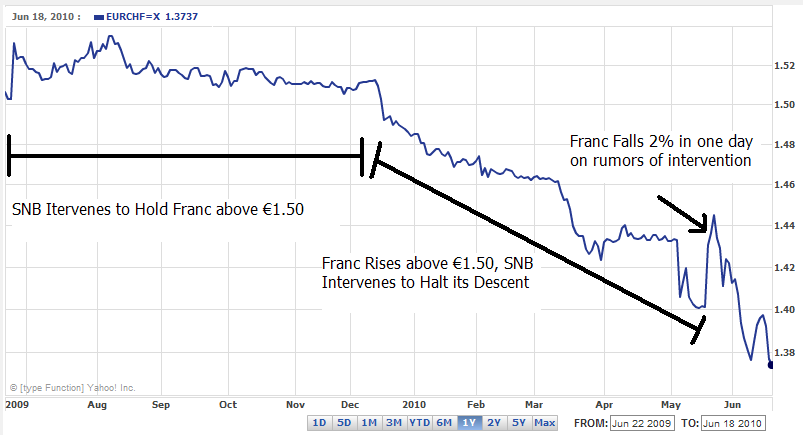
Still, the SNB should be applauded for its efforts. As you can see from the chart above, it managed to keep the Franc from rising above €1.50 (its so-called line in the sand) for the better part of 2009. Furthermore, by most accounts, it managed to slow the Franc’s unavoidable descent against the Euro in 2010. While the Dollar has appreciated more than 15% against the Euro, the Franc has a risen by a more modest 10%. ” ‘Without that €90 billion [intervention], it’s fair to say that the euro would be closer to $1.10,’ ” argued one analyst. In fact, as recently as May 18, the SNB manifested its power in the form of 1-day, 2% decline in the Franc, its sharpest fall in more than a year.

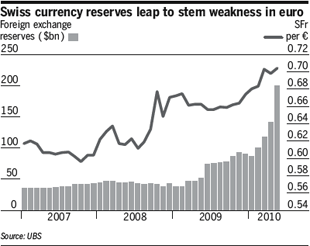
Overall, the SNB has spent more than $200 Billion over the last 12 months, including $73 Billion in the month of May alone. ” ‘To put the figures in perspective, there have been only two months when China, the world’s largest holder of forex reserves with $2,249bn in assets, saw its reserves increase more.’ ” The SNB now claims the world’s 7th largest foreign exchange reserves, ahead of the perennial interveners of Brazil in Hong Kong, the latter of whose currency is pegged against the Dollar.

Swiss SNB Forex Reserves - Intervention
While the SNB can take some credit for halting the decline in the Franc, it was ultimately done in by factors beyond its control, namely the Eurozone sovereign debt crisis and consequent surge in risk aversion. At this point the forces that the SNB is battling against are too large to be contained: “We’re talking about a massive euro crisis, so no single central bank can prop it up on its own,” summarized one trader. As a result, the Franc is now rising to a fresh record high against the Euro nearly every trading session.

Still, the SNB remains committed to rhetorical intervention. “The central bank has a ‘clear aim‘ to maintain price stability and this is what guides its policy actions, SNB President Philipp Hildebrand said…The bank will act in a ‘decisive manner if needed.’ ” That means that if economic growth slows and/or deflation sets it, it may have to restart the printing presses. Given that its economy is slated to grow at a solid 1.5% this year, unemployment is a meager 3.8%, and the threat of inflation has largely abated. On the other hand, the prospect of a drawn-out crisis in the EU means the Franc will probably continue to appreciate – without help from the Central Bank: ” ‘The SNB may continue to intervene in the currency markets until 2020,’ ” declared the head of forex research for UBS.

The implications for currency markets are interesting. Not only has the SNB prevented the Euro from falling too fast against the Franc, but it may also have prevented it from falling too quickly against other currencies. ” ‘To suggest that the SNB has been the savior of the euro is too much. But one could imagine that if the euro starts to decline again, the market may blame the fact that the SNB isn’t buying,’ ” said a currency strategist from Standard Bank.

This episode is also a testament to the limits of intervention. It has always been clear (to this blogger, at least) that intervention is futile in the long-term. The best that a Central Bank can hope for is to stall a particular outcome long enough in order to achieve a certain short-term policy aim. When enough momentum coalesces behind a (floating) currency, there is nothing that a Central Bank can do to stop it from moving to the rate that investors collectively deem it to be worth.

Scared of the Weekend?

In what has become a familiar pattern, Friday selling of risk assets heading into the weekend is taking place as the risk posed by the Euro zone debt crisis is still prevalent. In fact, various policy makers around the globe have expressed concern about the Euro zone, even as the market has been in risk-taking mode as of late.

Today there is a lack of market making news so we’ll turn our attention to more macro themes, one of them being oil prices. It was only a matter of time before fallout from the oil spill in the US began to show up in the markets. The proposed ban on offshore drilling will only reduce supply, thereby causing prices to move higher. The cruel irony is that this would actually benefit BP, the company responsible for this disaster. That means higher prices for consumers.

This is also falls in line with yesterday’s discussion of biflation, where we are likely to see higher commodity prices yet debt-based asset prices go lower.

If the usual correlations hold up, this will benefit the Canadian dollar the most, and the US dollar the least. It’s amazing to think that even in the face of nascent recovery, that oil prices are around $75/barrel. What would it be if we were in full-blown recovery mode? Conspiracy theorists will tell you that high oil prices increase the demand for alternative energy, one of the largest pieces of the Obama agenda. Now I’m not a conspiracy theorist, however I believe in “cui bono”, meaning who stand to benefit the most. You decide for yourself.

So this morning we’re seeing some mild risk aversion, as traders wish to avoid weekend risk from the Euro zone.

In the forex market:

Aussie (AUD): Risk aversion is pushing the Aussie slightly lower going into the weekend. If commodity inflation persists, higher gold prices would benefit the Aussie.

Kiwi (NZD): Same as the Aussie though slightly lower following the “risk ladder”.

Loonie (CAD): The Loonie is lower as oil prices have pulled back as there is concern over the pace of global recovery. In addition the BOC said that there are no “pre-ordained” rate hikes, leaving the door open for a possible pause.

Euro (EUR): The Euro is lower as the ECB head maintained that rates were appropriate in light of the debt situation in the region. However, German PPI figures came in higher than expected, showing signs that inflation may be heating up in the Euro zone’s largest economy.

Pound (GBP): The Pound has given back overnight gains that pushed it to 1,4885 vs. USD. Next Tuesday, the government will release its budget statement that is expected to show a significant deficit and major cost-cutting measure to combat that problem. So far, the market has reacted favorably to the plan as the Pound has had recent gains.

Dollar (USD): The Dollar is slightly higher on risk-aversion, as traders use the safe-haven aspects as a temporary holding vessel.

Yen (JPY): Consumer lending and bank stocks fell on the Nikkei taking the index lower and causing a rise in Yen. In addition, the BOJ is concerned about the Euro zone debt crisis spreading to Japan according to it rate policy meeting’s minutes.

On a day that is light on news, the markets may not tend to move much. As of right now, the market is largely unchanged, with a slight bias toward risk-aversion.

This just goes to show that the daily news events that occur around the globe really do have an impact on the currency and other financial markets. While one doesn’t need to be an expert economist to understand why things move as they do, it is important to know if there is news for a specific currency you like to trade.

And that is the purpose of this blog; to give readers a brief run-down of what’s happening so that they may be aware of potential drivers or obstacles to their favorite currency pair.

So I expect today to be a quiet one, with the start of the summer season picking up as the market slows. In fact, I am on a long vacation weekend myself!


Affordable SEO | SEO Experts | SEO Specialist | SEO Packages | Best SEO India