The Trend is Your Friend

Raise your hand if you’ve ever heard that expression before? Well, now there’s proof that this well-worn phrase is more than just a pointless platitude: “Royal Bank of Scotland Group indexes that track the performance of four of the most popular currency strategies show that the so-called trend style was the best-performing method, returning 7.3 percent this year through August.”

“Trend-Style” trading is also known as trend-following, and is just as it sounds. Traders identify one-way patterns in specific currency pair(s), and attempt to ride them for as long as possible. Given all of the big movements in currency markets this year, it’s no wonder that trend-following is the most popular. If you look at the 52 week trading ranges for the six most popular USD currency pairs, you can see that highs and lows are often as far as 20% apart. The EUR/USD pair, for example, fell 20% over a mere 7 months. Anyone who sold in December 2009 and bought to cover in June 2010 would have earned an annualized return of 35% without leverage! Even if you had captured only a couple months of depreciation would have yielded impressive returns. In addition, you could have traded the Euro back up from June until August and reaped a 60% annualized return. Best of all, both of these trends (down, then up) unfolded very smoothly, with only minor corrections along the way.
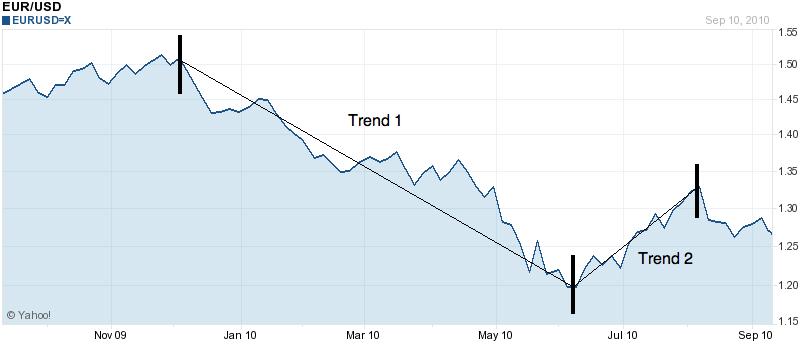
The Trend is Your Friend- USD/EURI’m sure serious technical analysts are rolling their eyes at the chart above, but the point stands that trend-following has never been easier and rarely more profitable than it is now. One fund manager summarized, “Trend-following investors are capturing the momentum in several big currency moves. You have so much uncertainty in the world now with regard to inflation or deflation, which typically makes currency markets and interest rates move. That is good for trend followers as it causes volatility, which typically creates good profits.” In other words, there is a tremendous amount happening in forex markets at the moment, and this is reflected in protracted, deep moves in currency pairs, which can change direction without notice and yet continue moving the opposite way for just as long. If you think this sounds obvious, look at historical data (5-10 years) for the majority of currency pairs: while trends have always been abundant, it was only recently that they began to last longer and became more pronounced.

The other three strategies surveyed by the Royal Scotland Group (”RSG”) were theCarry Trade, Value Trade, and Volatility Trade. Unfortunately, data was only offered for the carry trade strategy (confusingly referred to by RSG as the volatility strategy), which is down 5.9% in the year-to-date. The carry trade strategy involves selling a currency with a low yield and favor of one with a high yield, and profiting from the interest rate spread. In order for this strategy to be profitable, however, the long currency must either appreciate or remain constant. Thus, when volatility is high – as it has been over the last 2-3 years – this is a losing strategy.

We can only guess that a true volatility strategy probably would have been the second most profitable strategy. This strategy can be implemented through the use of long and short spot positions, as well as through trading in options and other derivatives. As I said, there is no shortage of volatility at the moment: “Since the collapse of Lehman Brothers in 2008, the dollar has seen record volatility against the euro…including six moves of at least 10%.” For traders that profit from volatility, the current uncertainty has created a windfall situation.

Getting Better, But Not There Yet!

This morning, US initial jobless claims came in better than expected showing 451K new claims vs. an expectation of 470K. While this is a step in the right direction, it is still at unacceptably high levels and may remain there for some time unless we get a shift in government policy.

Earlier in the morning, the BOE maintained current monetary policy as was expected, so recent signs that inflation concerns may be rising will be revealed from the monetary policy meeting minutes due out in about two weeks. The pound is weaker as a result.

Overnight, the Australian employment change came in better than expected as well, reporting a gain of 31K vs. an expectation of 25K.

So the market is in a bit of risk-taking mode to start the day, led by the commodity currencies and the Euro.

In the forex market:

Aussie (AUD): The Aussie is higher as risk appetite has returned to the market this morning. Better than expected employment figures have increased demand as the Australian economy still appears to be operating on all cylinders, with the jobless rate at 5.1%.

Kiwi (NZD): The Kiwi is higher on risk taking despite the fact that home prices increased at their slowest pace as consumer borrowing declined as home interest rates increased. In addition, weaker manufacturing figures showed that growth may be slowing.

Loonie (CAD): The Loonie is also higher falling in line with risk themes and its appropriate place in the risk hierarchy. Providing an additional bid is higher oil prices, which have increased to 75.50. However, housing starts came in less than expected and the Canadian trade deficit widened to the largest levels on record, as lack of US demand hurt exports.

Euro (EUR): The euro is mixed today under classic risk-taking scenarios. The market is brushing off “news” that comments from an ECB member claimed that German banks are also under-capitalized. In Germany, CPI data came in slightly better than expected, though still showing that inflation is tame.

Pound (GBP): The Pound is lower across the board as the BOE maintained monetary policy as expected. In addition, the UK trade balance figures showed a wider than expected trade deficit, most likely the result of recent Pound strength.

Dollar (USD): The Dollar is mostly lower, including against the Yen as US stocks are higher after the “encouraging” initial jobless claims figures.

Yen (JPY): The Yen is mostly lower, though posting slight gains against the Pound and Dollar. Overnight, consumer confidence figures came in lower than expected and tonight Japanese GDP figures are expected to show growth of .4% for the quarter, with the annualized figure at 1.5%. However, the huge story is still over Yen intervention, and the market appears to be testing government resolve.

Today’s initial jobless claims figures are giving the bulls a reason to push markets higher despite the fact the figure is still bad by historical standards. I guess you have to take your small victories where you can get them.

Meanwhile, in the UK the BOE appears to be discounting inflation concerns in favor of hoping to encourage further growth.

I’m becoming very skeptical of news coming out of the EU regarding the debt crisis as it seems to be a convenient way to attempt to keep the Euro low to help encourage exports. Until action is needed and a problem occurs, I am content to remain positive that the ECB will handle it.

The commodity currencies keep chugging along as those economies appear to be doing better than the more established ones.

And lastly all eyes are on Japan as the intervention talk heats up with every day’s Yen appreciation vs. the Dollar.

To learn more about how you can take advantage of world events through the currency market, be sure to check out our currency trading courses!

CFTC Passes New Retail Forex Guidelines

have been covering the US Commodity Future Trading Commission’s (CFTC) efforts to revamp the regulatory structure that governs forex, since it was unveiled earlier this year. On August 30, the CFTC formally published the “final regulationsconcerning off-exchange retail foreign currency transactions. The rules implement provisions of the Dodd-Frank Wall Street Reform and Consumer Protection Act and the Food, Conservation, and Energy Act of 2008, which, together, provide the CFTC with broad authority to register and regulate entities wishing to serve as counterparties to, or to intermediate, retail foreign exchange (forex) transactions.”

Not only has the CFTC clearly established its authority to be the primary regulator of retail forex, but it has also laid out specific regulations. Chief among them is limiting leverage to 50:1 for major currency pairs, and 20:1 for “other retail forextransactions.” [It's not presently clear which specific currency pairs will be classified as major]. Remember that the original proposal (which, along with my endorsement, generated vehement protest) called for a decline in leverage to 10:1. Due to negative feedback from traders and brokerages, which ascribed malicious political motives to the changes and argued that it would move the entire industry offshore, the CFTC backed down and implemented only a modest decline in leverage. However, it’s important to note that the National Futures Association (NFA) as well as individual brokers will have discretionary power in setting leverage limits lower than 50:1. There will undoubtedly still be some opposition from traders, but I think we can all agree that the new rule represents a fair compromise.

As for the claim that traders would/will move their accounts offshore, this will become largely moot, since all brokerages, regardless of nationality, will be required to register with the CFTC and subject to its rules/oversight. Of course, those traders that are so inclined will still find a way to circumvent the rules by shifting funds “illegally” to unregistered brokers, but they do so at their own risk and will have no recourse in the event of fraud. As Forbes noted, “It seems these new rules will put a stop to Americans trading retail forex offshore to evade CFTC rules. That trend picked up the pace in recent years and it may need to be reversed quickly.”

Brokerages must register as either futures commission merchants (FCMs) or retail foreign exchange dealers (RFEDs). These institutions will be required to “maintain net capital of $20 million plus 5 percent of the amount, if any, by which liabilities to retail forex customers exceed $10 million.” While this rule will raise the barriers to entry for potential forex start-up brokerages, it will protect consumers against broker bankruptcy. In addition, “Persons who solicit orders, exercise discretionary trading authority or operate pools with respect to retail forex also will be required to register, either as introducing brokers, commodity trading advisors, commodity pool operators (as appropriate) or as associated persons of such entities.”

One final rule change worth noting is quite interesting: brokerages must “disclose on a quarterly basis the percentage of non-discretionary accounts that realized a profit and to keep and make available records of that calculation.” This calculation will be useful both in and of itself, and also in identifying any significant discrepancies between competing brokers. For the first time, we will be able to see whether forextrading is currently profitable (i.e. whether those that profit are in the majority or minority) and whether/how this profitability metric changes over time, in response to particular market conditions.

Weighing Risk in Forex Positions

When opening a Forex position it’s very important to consider your own maximum risk tolerance, which usually depends on the account size and the stop-loss of the said position. Risking only a small fixed fraction of your account balance is a nice way to limit your losses and to organize the whole trading process. But there is also another risk factor that’s often overlooked by the traders and is rarely used when opening a new position — a risk of trade (or its success probability).

A risk of trade can be measured as the expected success rate of the position. For example, if you saw Fed raising interest rate unexpectedly it’s almost a surefire bet (with about 90% probability) that the USD will go up at least slightly. Position based on this signal can be characterized as the low-risk one. And if (for example) usually you risk about 1% of your capital per each trade, for this position you could increase its size to risk, let’s say, 2%. For the opposite example, let’s presume that you are trying out some new Forex signal service and consider that relying on it is quite risky. So, the usual 1% of the initial capital risk can be reduced to 0.5%.

The problem with this risk of success is that it’s very subjective and there is no good way to measure it precisely. A trader would need to rely on his experience and intuition to weigh the risk into his positions. But some approximate system of risk weighing can be organized even by rather new Forex traders and the result of its implementation would be quite nice.

So, next time when you see a nice signal and go to some position size calculator (or even if you do it manually), consider evaluating a probability of trade’s success and alter the position size accordingly.

Australia Dollar Ebbs and Flows with Risk

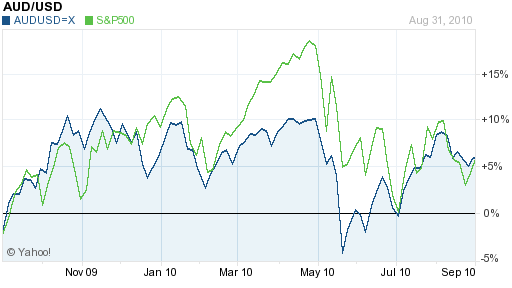
If you chart the course of the Australian Dollar over the last twelve months alongside the S&P 500, the overlap is jarring. You can see from the chart below that the two lines zig and zag in almost perfect unison. It would seem that there was a slight break in the second quarter of 2010, but even this is an illusion, since the Aussie and the S&P continued to rise and fall in the same patterns over that time period, differing only in degree of fluctuation.

Australian Dollar Versus S&P 500: 2009-2010
Since the S&P 500 is a pretty good proxy for risk it can be said that the Australian Dollar is a manifestation of investor risk appetite. When risk aversion was high, the S&P and the Aussie were low. When risk tolerance picked up, they rose. It’s funny how this came to be. It is probably best seen as a vestige from the credit crisis, whereby investors evenly divided assets into two classes: risky and safe. When you look at the performance of the Australian Dollar, it is pretty clear as to which side of the dividing line it was placed.

This is probably fair, since the Australian Dollar is a growth currency. According to the just-released Bank of International Settlements (BIS) Triennial Central Bank Survey of Foreign Exchange and Derivatives Market Activity, the Australian Dollar is now the world’s fifth most traded currency (behind only the G4: Dollar, Euro, Yen, & Pound), having usurped that position from the Swiss Franc. In 2010, it accounted for 7.6% (out of a total of 200%) of all trading volume, primarily as a result of trading in the USD/AUD currency pair, which was the fourth most popular in forex.

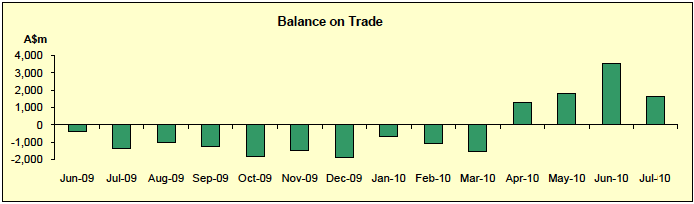
Investors have come to see the Australian Dollar in somewhat contradictory terms. It is both stable and liquid, but its economy is unpredictable and inflation is usually above average. The current economic situation was strong, with GDP growth projected to exceed 3% in 2010. Its benchmark interest rate (4.5%) is the highest in the industrialized world, and may touch 5% before the year is over. On the other hand, its political situation is currently uncertain, thanks to an election that produced a hung Parliament and the recent resignation of its Prime Minster. In addition, while its trade balance is currently in surplus, it fell in July thanks to decreased demand from China. Analysts wonder whether it isn’t entirely dependent on China (directly via exports and indirectly via high commodity prices) to generate positive GDP growth.

Australia Balance of Trade - 2009- July 2010
Ultimately, investors don’t care about any of this. They care only whether the global economy is stable and whether another financial/credit/economic crisis is likely to occur. Even though any such crisis will probably spare Australia, the Aussie is punished by even the whiff of crisis because Australia is perceived as being riskier to invest than the US, for example. “The Australian dollar is going to stay heavy. Markets don’t like uncertainty,” summarized JP Morgan.

Sadly, it’s currently not worth parsing the nuances of trade statistics and monetary policy, because it has no bearing on the Aussie, though at least this makes my job easier. For the time being, the Australian Dollar will tick up if it looks like the global economy (principally the US) will avoid a double-dip recession. Otherwise, it is in for the same rough stretch as the S&P.

Trading In Emerging/Exotic Currencies Increases

The long wait is over! The Bank of International Settlements (BIS) has just released the results from its Triennial Central Bank Survey of Foreign Exchange and Derivatives Market Activity, conducted in April 2010. The report contains a veritable treasure trove of data, perhaps enough to keep analysts busy until the next report is released in 2013. [Chart below courtesy of WSJ.

Daily Turnover in Forex Markets

First, the data confirmed earlier reports average daily forex volume had surged to a record level in 2010: “Global foreign exchange market turnover was 20% higher in April 2010 than in April 2007, with average daily turnover of $4.0 trillion compared to $3.3 trillion. The increase was driven by the 48% growth in turnover of spot transactions, which represent 37% of foreign exchange market turnover. The increase in turnover of other foreign exchange instruments [consisting mainly of swaps and accounting for the majority of forex trading activity] was more modest at 7%.” In addition, for the first time, investors and financial institutions accounted for a larger share of turnover than banks, whose trading activity has remained roughly unchanged since 2004.

The composition of the turnover actually didn’t change from 2007, interrupting a shift which had been taking place over the previous 10 years. Specifically, the share of overall turnover accounted for by the so-called major currencies actually increased in 2010, from 172% to 175%. [Since there are two currencies in every transaction, total volume sums to 200%]. Growth in the G4 currencies (Dollar, Euro, Pound, Yen) was more modest, however, increasing from 154% to 155%. This reversal is probably attributable to the credit crisis, which drove (and in fact, continues to drive) investors out of emerging market currencies and back into safe haven currencies, namely the Dollar, Yen, and Pound. However, this theory is belied by the significant increase in Euro trading activity, which certainly hasn’t benefited from the recent trend towards risk aversion.

Forex Composition, Major Currencies Versus Emerging Currencies

While emerging currencies as a group accounted for a smaller share of overall activity, certain individual currencies managed to increase their respective shares. The Singapore Dollar, Korean Won, New Turkish Lira, and Brazilian Real all fit into this category. Still other currencies, such as the Indonesian Rupiah and Malaysian Ringgit, also managed impressive gains but account for such a small share of volume as to be insignificant when looking at the overall the picture. Those who were expecting even bigger growth should remember that it’s ultimately a numbers game: the amount of Ringgit it outstanding is dwarfed by the number of Dollars, so any gains that the Ringgit can eke out are impressive. In addition, when you consider that the overall forex pie is also increasing, the nominal increase in volume for these small currencies was actually quite large.

Growth in Emerging Currencies Forex Volume
The ongoing search for yield in all corners of the financial markets is likely to bring some of the more obscure currencies into the fold. “In June, I began getting questions about Uruguay, Vietnam and others,” said Win Thin, senior currency strategist at Brown Brothers Harriman in New York…investors often asked Mr. Thin questions about less-familiar currencies such as the Ukrainian hryvnia and Romanian leu.” In the same article, however, Mr. Thin cautioned that interest in such currencies is still probably lower than in 2007-2008, for a good reason. “It’s not like the Group of 10, or even the more liquid emerging market currencies where, if you decide you’ve made a mistake, you can get out.”

Due to the lack of liquidity these obscure currencies aren’t really suitable for trading. Of course there will be a handful of institutional and even retail investors that want to make long-term bets on these currencies. They tend to be more aware of the risk and less sensitive to the higher cost and lower convenience. The overwhelming majority of traders, however, churn their portfolios daily, if not hundreds of times per day. A 10pip spread on the USD/MXN (Dollar/Mexican Peso) would be considered too high, let alone a 50 pip spread on any transaction involving the Ukrainian hryvnia.

In short, the majors will account for the majority of trading volume for the foreseeable future, regardless of what happens to the Euro. At the same time, that won’t prevent a handful of selected emerging currencies, such as the Chinese Yuan, Indian Rupee, Brazilian Real, and Russian Ruble from increasing their share. As liquidity rises and spreads decline, volume will increase, and their rising importance will become self-fulfilling.

Emerging Markets Rally, Despite Eurozone Debt Crisis

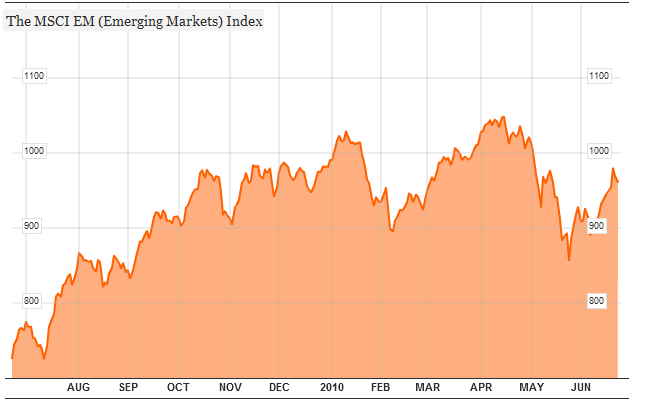
It looks like emerging market investors took my last post (“Investors” Shouldn’t Worry about the Euro) to heart, since emerging markets (EM) have continued to rally in spite of the Euro’s woes. To be sure, EM stocks, bonds, and currencies all dipped slightly in May when the crisis reached fever pitch, but they have since recovered their losses and are once again en route to record highs.

MSCI Stock Index 2010

That’s not to say that that surge in risk-aversion wasn’t justified. In fact, investors are continuing to punish the Eurozone as well as a handful of other risky areas. However, analysts have concluded that in the case of emerging markets as a whole, this mindset doesn’t really make sense.

Simply, the fiscal and economic condition of is stronger than in developing countries. Whereas previously crises were known to originate in developing countries and spread to industrialized countries, this latest series of crisis turned that notion on its head. The credit and housing crises were largely the product of speculation in the West, and the sovereign debt crisis originated in Europe. While it’s possible that investor concern would self-fulfillingly cause the crisis to spread to emerging markets, any impact would probably be muted.

There is recognition that emerging market balance sheets are strong and the debt to GDP ratio is below 40 per cent compared to the western world, where it is over 100 per cent in many countries,” summarized one analyst. “The vast majority of emerging market countries ‘have the tools to tackle inflation and will succeed, having reasonable independence from their central banks,’ ” added another.

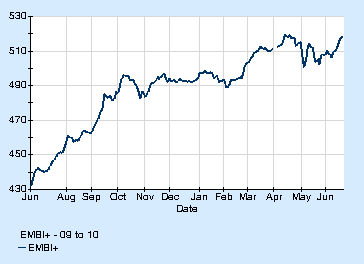
Thus, the funds continue to pour in. “Net inflows into emerging market debt totalled $30.6bn (£20.7bn, €25bn) from the beginning of the year to late May compared with $33bn for the whole of 2009.” Here’s another sign of EM confidence: “IPOs in developing countries raised $29.3 billion this quarter, almost three times the amount in industrialised nations.” Meanwhile, the MSCI Emerging Market Stock Index has just finished its strongest rally since 2005, and the JP Morgan Emerging Market Bond Index (EMBI+) is closing in on another record high. This is frankly incredible when you consider that around half of the countries with the largest weightings in the index have experienced debt crises of varying severity over the last decade.

EMBI+ bond index 2010
As far as forex investors are concerned, the confidence in EM capital markets should also extend to currencies. The carry trade is heating up (thanks to the cheap Euro), and will probably only expand as EM Central Banks move to raise interest rates to combat inflation, as alluded to above. If the Eurozone debt crisis intensifies, then you can expect some kind of pull-back. As with recent retracements, however, it will be only temporary.


Affordable SEO | SEO Experts | SEO Specialist | SEO Packages | Best SEO India